
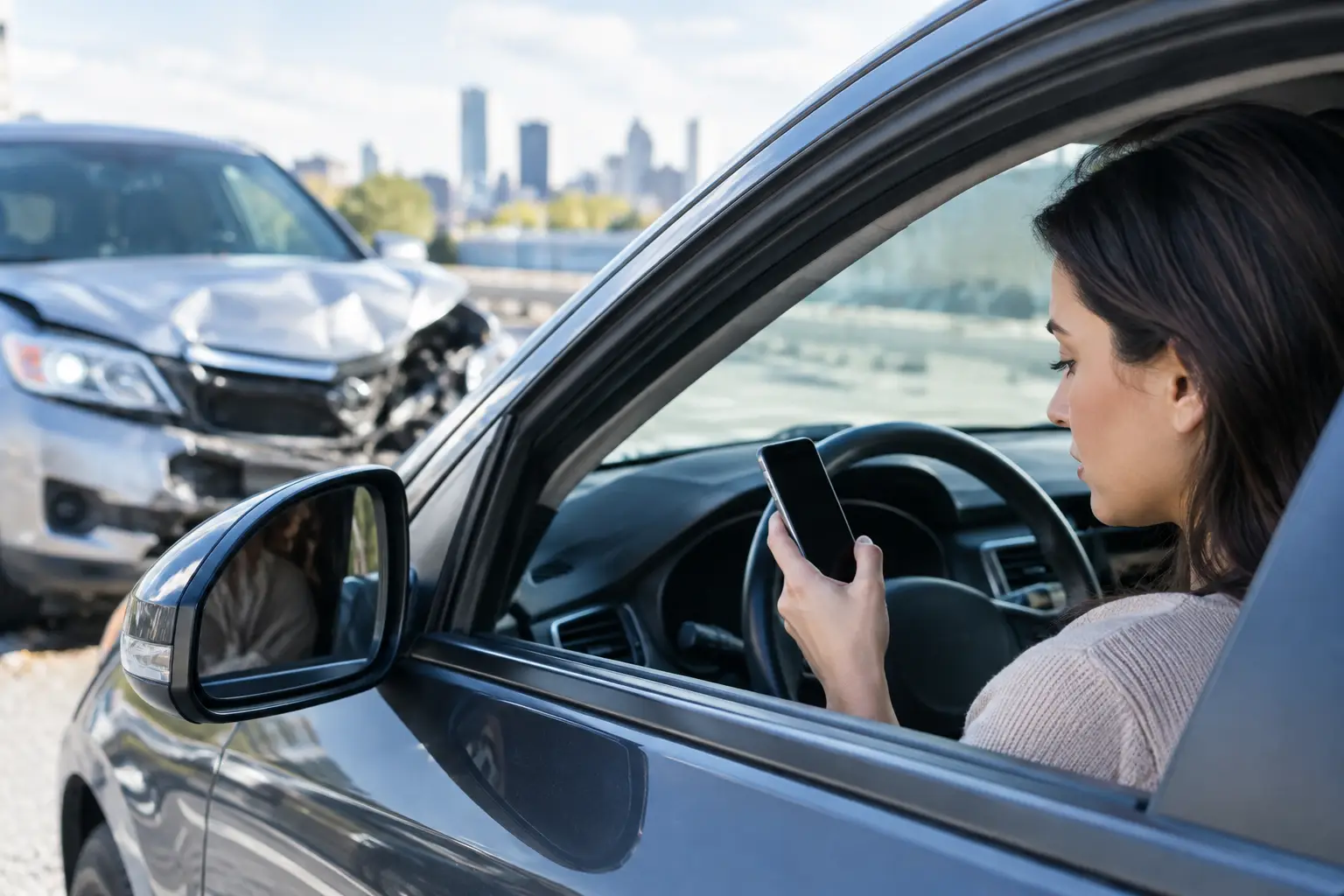
A driver looks down for a few seconds. A car drifts across a lane, misses a stopped vehicle, or strikes a pedestrian in a crosswalk. Then the driver says they never saw what happened. In many New York crash claims, distracted driving evidence is what separates a preventable collision from one person’s word against another.
If you were hurt, do not assume the police report will tell the whole story. Phone records, vehicle data, nearby cameras, app activity, and witness accounts can reveal what a driver was doing in the moments before impact. Much of that evidence is temporary. Acting quickly can protect your ability to prove fault and pursue the compensation you need for medical care, lost income, and the harm the crash caused.
What Counts as Distracted Driving?
Distracted driving is more than texting behind the wheel. It includes any activity that takes a driver’s eyes, hands, or attention away from safely operating a vehicle. A driver may be visually distracted by a phone screen or navigation system, manually distracted while reaching for an item, or cognitively distracted while focusing on a call, argument, passenger, or work task instead of traffic.
Common examples include texting, scrolling social media, entering directions, changing music, eating, grooming, turning around to address a child, or using a delivery or rideshare app. Commercial drivers may also be distracted by dispatch messages, fleet devices, paperwork, or in-cab technology.
The legal question is not simply whether a driver touched a phone. The question is whether their conduct fell below the level of reasonable care expected on the road and caused the collision. A driver can violate that duty in a split second.
Why Distracted Driving Evidence Matters
After a crash, an at-fault driver may deny using a phone or claim the collision was unavoidable. Insurers often look for reasons to shift blame onto the injured person, especially when there is no clear video of the impact. They may argue you stopped too quickly, crossed outside a crosswalk, changed lanes improperly, or failed to avoid the crash.
Strong evidence can challenge those arguments. It can show that the other driver was looking down, failed to brake, ignored traffic conditions, or was actively using a device when they should have been watching the road. It may also establish that a trucking company, delivery company, or rideshare-related business had records relevant to the driver’s conduct.
Evidence matters even when fault seems obvious. A rear-end crash, for example, may strongly suggest the rear driver was negligent, but phone use or vehicle data can explain why the driver never reacted. That proof can make it harder for an insurer to minimize the seriousness of the wrongdoing or pressure you into accepting less than the claim is worth.
Cell Phone Records and Device Data
Cell phone records can be valuable, but they are not as simple as checking whether a text was sent at the exact second of a crash. A record may show calls, texts, or data activity close in time to the collision. Depending on the circumstances, device data, app activity, messages, photos, and location information may also become relevant.
There are limits. A phone record may show data use without identifying precisely what the driver was looking at. A hands-free call is not automatically proof of negligence. The surrounding facts still matter: traffic, speed, weather, reaction time, witness observations, and the driver’s own statements.
A lawyer can seek to preserve relevant information before it is lost, deleted, overwritten, or replaced. This is particularly important when a serious crash may lead to litigation. Do not try to access another driver’s phone or accounts yourself. That can create legal problems and may compromise the investigation.
Video Often Has a Short Shelf Life
Video can be among the clearest forms of distracted driving evidence, but it can disappear quickly. Nearby businesses, apartment buildings, homes, parking lots, buses, and traffic cameras may have footage showing the vehicles before or during the crash. Dashcams and doorbell cameras may capture an angle no one else saw.
Many systems automatically overwrite footage within days or weeks. By the time an insurance company finishes its initial review, the recording may already be gone. Prompt preservation requests can be critical, especially after a crash near a busy Queens intersection, a commercial loading area, or a transit route.
Video does not need to show the driver holding a phone to be useful. It may show delayed braking, lane drifting, a vehicle speeding through a red light, or a driver failing to yield. Those details can support the larger case that the driver was not paying attention.
Vehicle Data, App Records, and Commercial Evidence
Modern vehicles often record operational information through event data recorders. Depending on the vehicle and crash, that data can help show speed, braking, steering input, seat belt use, and other events immediately before impact. It cannot always prove distraction on its own, but it can expose a driver’s failure to react.
For commercial vehicles, the potential evidence is broader. Delivery vans, trucks, taxis, and fleet vehicles may have GPS records, dashcams, dispatch communications, electronic logs, onboard cameras, or telematics data. Rideshare crashes can raise additional questions about whether the driver was logged into an app, headed to a pickup, or carrying a passenger at the time.
Companies do not always volunteer records that could hurt their defense. A fast, thorough investigation is often necessary to identify who controls the information and preserve it before routine retention policies erase it.
Evidence You Can Protect After a Crash
Your health comes first. Call 911, accept emergency care when needed, and follow up with a medical professional even if pain seems manageable at the scene. Adrenaline can mask injuries, and delayed treatment can give insurers an opening to question whether the crash caused your condition.
If you are physically able, take photos and video of the vehicles, road, debris, traffic signals, skid marks, weather, and visible injuries. Get the names and contact information of witnesses. Ask whether anyone saw the driver looking down, holding a phone, swerving, or failing to stop.
Keep copies of your medical records, bills, work-loss documentation, repair estimates, and all insurance communications. Write down what you remember as soon as possible, including statements made by the other driver. A comment such as “I was checking directions” can matter later, even if the driver changes their story.
Do not post crash details, injuries, or activity updates on social media while your claim is pending. Insurance companies may use isolated posts or photos to argue that your injuries are less serious than reported. And do not give a recorded statement or sign a broad medical authorization simply because an insurance adjuster asks. You have the right to understand what you are being asked to provide.
How New York Fault Rules Can Affect Your Claim
New York generally allows an injured person to recover damages even if they share some responsibility for a crash. However, any percentage of fault assigned to you can reduce your recovery. That is why insurers focus so aggressively on blame.
Distracted driving evidence may protect you from unfair accusations, but it does not erase every other issue in a case. For example, an injured driver may have been using a phone too, driving too fast for conditions, or failing to wear a seat belt. Each fact must be evaluated honestly. A strong legal strategy addresses the defense arguments rather than pretending they do not exist.
The same principle applies to pedestrians and cyclists. A driver’s distraction can be central to the case, but insurers may still examine crossing location, visibility, traffic signals, and roadway conditions. The full picture matters.
When to Get a Lawyer Involved
You should consider speaking with an attorney promptly after a serious crash, particularly when there are significant injuries, a fatality, a commercial vehicle, a rideshare vehicle, disputed fault, or any reason to believe the other driver was distracted. Early involvement allows counsel to preserve evidence while it is still available and deal with insurers before their version of events takes hold.
At Kand Personal Injury Lawyers, we take on the investigation, insurance pressure, and legal burden so injured New Yorkers can focus on healing. There is no legal fee unless we recover compensation for you.
The most useful step is often the one taken before evidence disappears: preserve what you can, get medical care, and ask for help before a temporary video file, phone record, or witness memory is gone.