
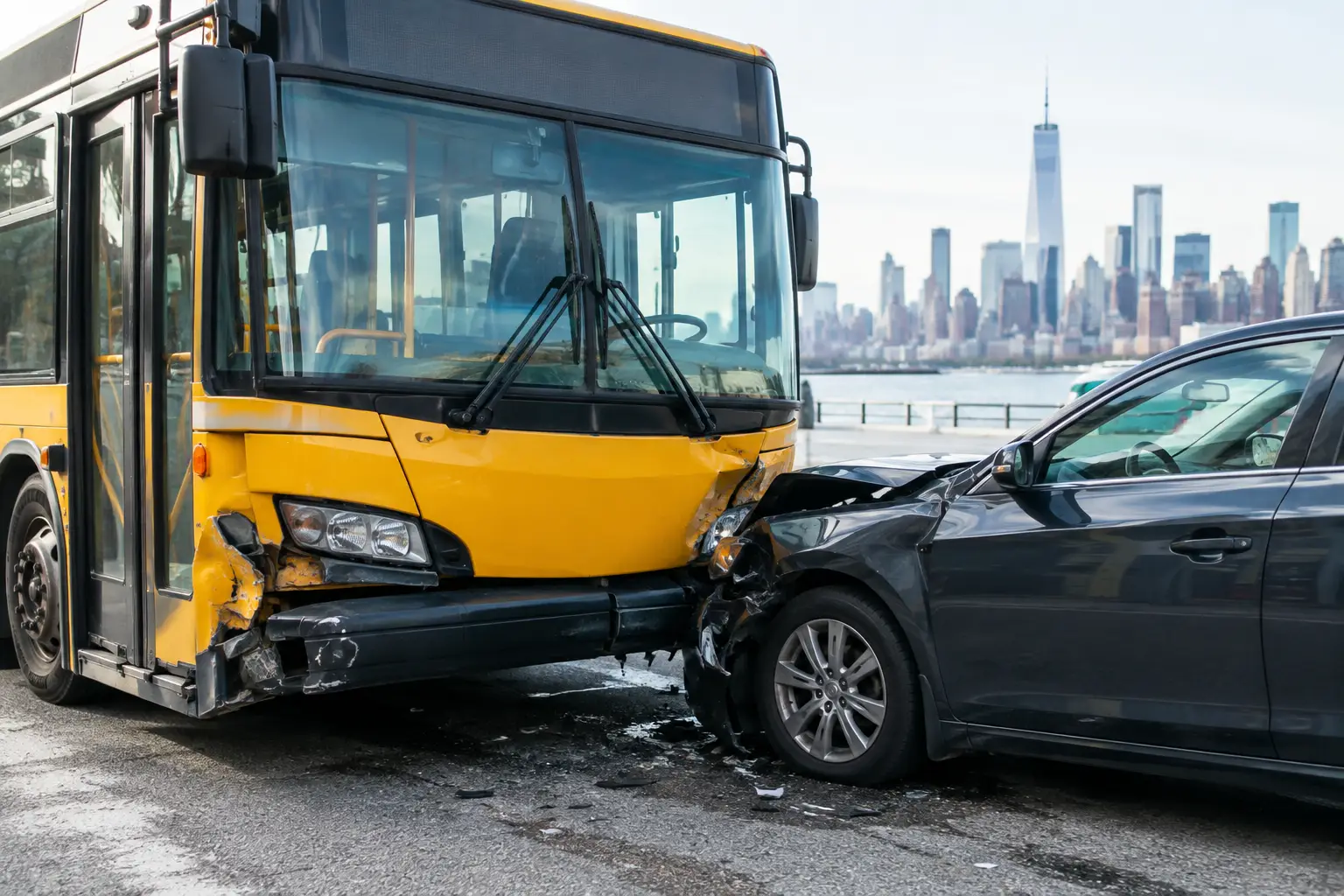
A bus collision can leave dozens of people asking the same urgent question: who is going to pay for the medical care, missed paychecks, and disruption to their lives? Bus crash liability is often more complicated than a typical car accident claim because a driver is rarely the only party with responsibility. A private bus company, the MTA, a school district, a maintenance contractor, or another reckless motorist may all be involved.
For an injured passenger, pedestrian, cyclist, or driver, the priority should be getting medical care and protecting the evidence before it disappears. The companies and agencies behind a bus typically have insurers, investigators, and lawyers working quickly to limit what they pay. You deserve someone prepared to protect your side just as aggressively.
Who Can Be Responsible for a Bus Crash?
Liability depends on how the collision happened, who owned and operated the bus, and whether the driver or another party failed to act with reasonable care. Bus drivers have a serious duty to operate safely around passengers, pedestrians, bicyclists, and surrounding traffic. When they speed, follow too closely, make unsafe turns, drive while distracted, ignore traffic signals, or fail to account for poor weather and road conditions, they may be liable for the harm that follows.
But the driver may not be the only responsible party. Under New York law, an employer can often be held responsible for the negligent acts of an employee who was working at the time of a crash. That can put a private charter company, tour operator, commuter bus company, school bus operator, or commercial transportation company on the claim.
In other cases, the bus company itself may have created the danger. For example, it may have hired an unqualified driver, allowed a fatigued driver to stay behind the wheel, failed to train operators properly, ignored prior safety complaints, or pushed unrealistic schedules that encouraged unsafe driving. A company that failed to inspect brakes, tires, steering components, lights, or emergency equipment may also face direct liability.
A crash involving an MTA or other public bus introduces another layer of complexity. The City of New York, the Metropolitan Transportation Authority, the New York City Transit Authority, or another public entity may be involved depending on the vehicle and route. These claims can have strict and unusually short notice requirements. Waiting until injuries have fully healed can be a costly mistake.
Bus Crash Liability May Involve More Than One Party
A bus can be hit by a speeding car, forced into another lane by a truck, or affected by a dangerous defect in the roadway. Even where the bus driver made an error, another party may share fault. For bus crash injury lawsuits, New York now applies a modified comparative negligence rule: an injured person’s compensation is reduced by their percentage of fault, and a person found more than 50% at fault is barred from recovering damages. Passengers, who were not driving, are rarely found at fault, but drivers and pedestrians involved in a bus crash may face aggressive fault arguments.
Potentially responsible parties may include:
- The bus driver or another negligent motorist
- The bus company, vehicle owner, or fleet manager
- A public transit authority or government agency
- A repair shop or maintenance contractor
- A manufacturer of defective bus parts or safety equipment
- A contractor responsible for unsafe road construction or traffic control
This matters because each party may have separate insurance coverage, records, and defenses. A bus company may blame a passenger for standing before the vehicle stopped. An insurer may claim a pedestrian stepped into traffic unexpectedly. A city agency may argue that it had no prior notice of a dangerous roadway condition. A thorough investigation tests those claims against the evidence rather than accepting the first version of events.
What Evidence Helps Prove a Bus Accident Claim?
The evidence in a bus crash case can be stronger than people realize, but much of it is controlled by the operator or agency. Video may be recorded by cameras inside the bus, facing the roadway, or mounted at nearby intersections. The vehicle may also contain electronic data showing speed, braking, steering, and other operational details before impact.
Police reports, witness statements, photographs, medical records, and damage documentation all matter. So do driver qualification files, hours-of-service records, training records, maintenance logs, inspection reports, prior incident reports, and communications about the route or vehicle. If a bus was operating for a private company, its dispatch records and GPS data may help establish where the bus was, how fast it was moving, and whether the driver was under pressure to stay on schedule.
Evidence can be overwritten, repaired, or lost if no one acts quickly. A lawyer can send preservation demands to put the relevant parties on notice that records, video, and the damaged vehicle must be retained. That early step can make a meaningful difference when liability is disputed.
What Happens if You Were a Passenger?
Passengers are often in a strong position because they were not driving either vehicle. Still, recovery is not automatic. The insurer may challenge the severity of injuries, argue that a condition existed before the crash, or try to characterize a serious injury as a short-term strain.
New York’s no-fault system may provide certain benefits for medical expenses and lost earnings after a motor vehicle accident, regardless of fault. However, no-fault benefits are limited and do not fully address the impact of a serious injury. To pursue pain and suffering damages in many motor vehicle cases, an injured person generally must meet New York’s serious injury threshold. Fractures, significant limitations, permanent injuries, and injuries that substantially affect normal daily activities may qualify, but every case turns on medical proof and the specific facts.
If the bus came to an abrupt stop, a passenger can have a claim even if there was no direct collision. The key question is usually whether the stop was unusually violent or unnecessary under the circumstances. Witness accounts, surveillance footage, and the driver’s explanation can become central to that issue.
Special Deadlines Apply to MTA and Government Bus Claims
A claim against a private bus company is different from a claim involving a city or public authority bus. Claims against government entities may require a notice of claim within as little as 90 days of the accident. In many cases, a lawsuit must then be filed within one year and 90 days, though the correct deadline depends on the specific public entity and type of claim.
These deadlines are far shorter than the time limits that may apply to a private negligence case. There are limited exceptions in some circumstances, but injured people should never assume an exception will apply. If an MTA, city, school district, or other public vehicle was involved, speaking with an attorney promptly is the safest way to identify the proper entity and preserve the claim.
Wrongful death cases have their own deadlines and procedural rules. A family coping with a fatal bus accident should not have to sort through agency forms and insurance demands alone while grieving. Legal guidance can protect the family’s ability to pursue accountability and financial support.
Compensation Should Reflect the Full Harm
A fair bus accident claim is not limited to the first emergency room bill. Serious injuries can require surgery, physical therapy, medication, mobility assistance, home care, and future treatment. They can also prevent someone from returning to the same work, supporting their family, or doing the everyday things they once took for granted.
Depending on the case, compensation may cover medical expenses, future care, lost income, reduced earning ability, pain and suffering, emotional distress, and property damage. In a fatal crash, surviving family members may seek damages tied to the financial losses caused by their loved one’s death.
Insurers often make early settlement offers before the full medical picture is clear. Accepting one may close the claim permanently, even if surgery, chronic pain, or a work disability emerges later. The right approach depends on the diagnosis, prognosis, available coverage, and evidence of fault. There is no responsible one-size-fits-all number.
Protect Your Claim After a Bus Accident
Get medical attention promptly, even when symptoms seem manageable at the scene. Adrenaline can hide pain, and delays in treatment give insurers room to question whether the crash caused the injury. Keep copies of discharge paperwork, bills, prescriptions, work-loss information, and communications from insurers.
Avoid giving a recorded statement or signing broad medical authorizations before you understand what is being requested. You should also be cautious with social media posts about the crash or your physical activities. Insurers look for any material they can use to minimize a claim.
At Kand Personal Injury Lawyers, we investigate bus crashes, identify every responsible party, and take on the insurance pressure so injured New Yorkers can focus on healing. We work on contingency, so there is no legal fee unless we recover compensation for you. If a bus crash has changed your life, getting clear legal advice early can protect options that may not be available later.