
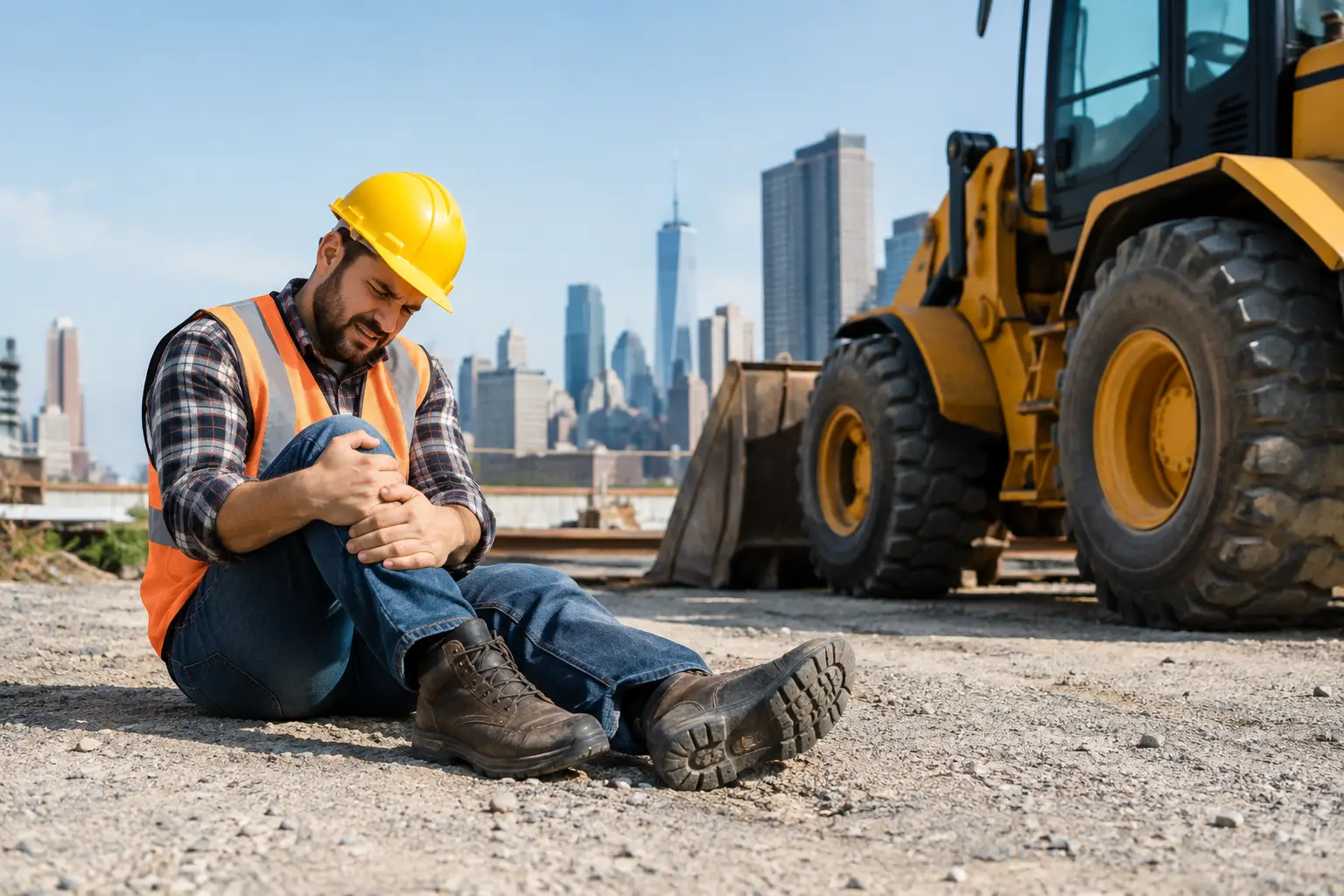
A dump truck turns across a lane. A forklift backs out of a work zone. A concrete mixer’s blind spot hides a pedestrian until it is too late. These collisions are not ordinary traffic accidents. This construction vehicle injury guide explains the steps that can protect your health, your evidence, and your right to pursue compensation after a serious New York crash.
Construction vehicles are large, heavy, and often operated in crowded areas with changing traffic patterns. The force of a collision can leave a driver, passenger, cyclist, pedestrian, or road worker with injuries that change daily life in seconds. While you are trying to get medical care and keep your household afloat, an insurance company may already be looking for a way to limit what it pays.
Get Medical Care and Report the Crash
Your first priority is medical treatment. Call 911 after a collision involving a construction vehicle, even when you think the pain will pass. Adrenaline can hide symptoms of a concussion, internal injury, neck or back trauma, and joint damage. An ambulance record, emergency room evaluation, urgent care visit, or prompt appointment with your doctor also creates a clear record connecting your injuries to the crash.
Tell medical providers about every symptom, including dizziness, headaches, numbness, sleep problems, anxiety, and pain that makes work or basic tasks difficult. Follow the treatment plan and keep your appointments. Gaps in care give insurers an argument that you were not seriously hurt or that something else caused your condition.
A police report is also valuable. Give the responding officer accurate facts, but do not speculate or accept blame. If you are physically unable to speak, focus on receiving care and provide details later when you are able. Ask how to obtain the report once it is available.
Preserve Evidence Before It Disappears
Construction vehicle cases can turn on evidence that is quickly erased, moved, or repaired. A truck may be returned to service, a work zone may be reconfigured, and video from a nearby business or traffic camera may be overwritten. If it is safe, take photographs and short videos of the vehicles, their positions, damage, debris, skid marks, traffic signals, warning signs, lane closures, weather, and visible injuries.
Get the names and contact information of witnesses. A bystander who saw a vehicle reverse without a spotter or run a red light may become critical if the driver later tells a different story. If the crash happened near a job site, note the company name on the truck, equipment, uniforms, trailer, or fencing. Record the vehicle’s license plate, DOT number, and any identifying markings.
Save the practical evidence, too. Keep damaged clothing, your helmet if you were cycling or riding a scooter, receipts for medication and transportation, medical paperwork, and written notes about your symptoms. A brief daily journal can show how pain, limited mobility, or emotional trauma affects your work, family responsibilities, and independence.
Do not post crash details, photographs, or updates about your recovery on social media. Insurers regularly search public accounts for material they can take out of context. A smiling photo at a family event does not prove that a person is uninjured, but it can still be used to attack a claim.
Why Construction Vehicle Claims Are Different
A construction vehicle crash may involve more than one responsible party. The person behind the wheel may be employed by a contractor, subcontractor, trucking company, equipment rental company, or a government agency. The vehicle might be owned by one company, maintained by another, and dispatched by a third. A careless driver is not always the only source of liability.
Investigators may need to examine driver training, licensing, hours-of-service records, cell phone use, maintenance logs, onboard cameras, dispatch records, vehicle data, and whether the company followed its own safety policies. For a crash in or beside a work zone, the traffic-control plan and site supervision may matter as well. Missing cones, poor lighting, unsafe lane closures, and a lack of a trained spotter can all contribute to a preventable collision.
New York’s no-fault insurance rules may provide certain basic benefits for people injured in motor vehicle crashes, regardless of fault. Those benefits can help cover medical expenses and a portion of lost earnings, but they are limited and subject to deadlines. A claim against the at-fault party for pain and suffering generally requires proof that the injury meets New York’s serious injury threshold. The facts, medical evidence, and insurance coverage all matter.
If a city, state, or other public entity may be responsible, notice requirements can be much shorter than the usual time to bring a lawsuit. Waiting to get legal advice can put a valid claim at risk. The same concern applies when a construction company’s records or video need to be preserved quickly.
Who May Be Responsible for Your Injuries?
Liability depends on the facts, not just on who made contact with whom. A thorough investigation may identify responsibility on the part of:
- The construction vehicle driver who sped, failed to yield, backed up carelessly, drove distracted, or ignored traffic controls
- The driver’s employer or the company that hired, supervised, dispatched, or retained an unsafe operator
- A contractor or site manager that created dangerous work-zone conditions or failed to use proper warnings and spotters
- A vehicle owner, maintenance provider, or manufacturer when defective equipment, brakes, lights, mirrors, or steering contributed to the crash
- Another motorist whose actions forced the construction vehicle or victim into danger
There are trade-offs in every case. A crash involving a private contractor may involve substantial commercial insurance coverage, but companies often deploy investigators and insurers immediately. A public-project case may raise special notice rules. A worker injured on the job may have a workers’ compensation claim as well as a separate claim against a negligent third party. The right strategy depends on identifying every available path to recovery without overlooking deadlines.
Be Careful With Insurance Adjusters
An adjuster may sound sympathetic and still be working to reduce the value of your claim. You are not required to give the other side a recorded statement immediately after a serious crash. You should also be cautious about signing broad medical authorizations or accepting an early settlement before your diagnosis and treatment needs are clear.
Early offers often arrive before a victim understands the full cost of surgery, physical therapy, lost income, future care, or a permanent disability. Once a settlement is signed, you generally cannot return for more money because your condition became worse. The goal is not to delay for the sake of delay. It is to understand what the injury has truly taken from you before placing a value on your case.
Compensation After a Construction Vehicle Collision
A successful personal injury claim may seek compensation for medical bills, rehabilitation, lost wages, reduced earning capacity, pain and suffering, and out-of-pocket costs connected to the crash. When an injury requires future treatment or prevents a return to the same work, the claim should account for those long-term consequences, not just the first few weeks after the collision.
For families grieving a fatal construction vehicle crash, a wrongful death claim may seek damages tied to the financial and practical losses caused by the death. No legal case can replace a loved one. It can, however, hold negligent parties accountable and help a family address the financial pressure that follows an unimaginable loss.
When to Speak With a Construction Vehicle Injury Lawyer
You should consider speaking with an attorney promptly when an injury is serious, liability is disputed, a commercial vehicle was involved, or an insurer is pushing for a quick statement or settlement. Legal counsel can send preservation notices, obtain records, coordinate the investigation, calculate losses, and deal with the insurers while you focus on healing.
At Kand Personal Injury Lawyers, injured New Yorkers can get direct guidance without paying a legal fee unless the firm wins compensation. A construction vehicle case demands early action and a willingness to challenge the companies and insurers that try to shift blame onto the injured person.
If you or someone you love was hit by a dump truck, forklift, excavator, cement mixer, or other construction vehicle, protect the evidence while it is still available. Get medical care, keep records, and seek informed legal advice before an insurer decides what your future is worth.